
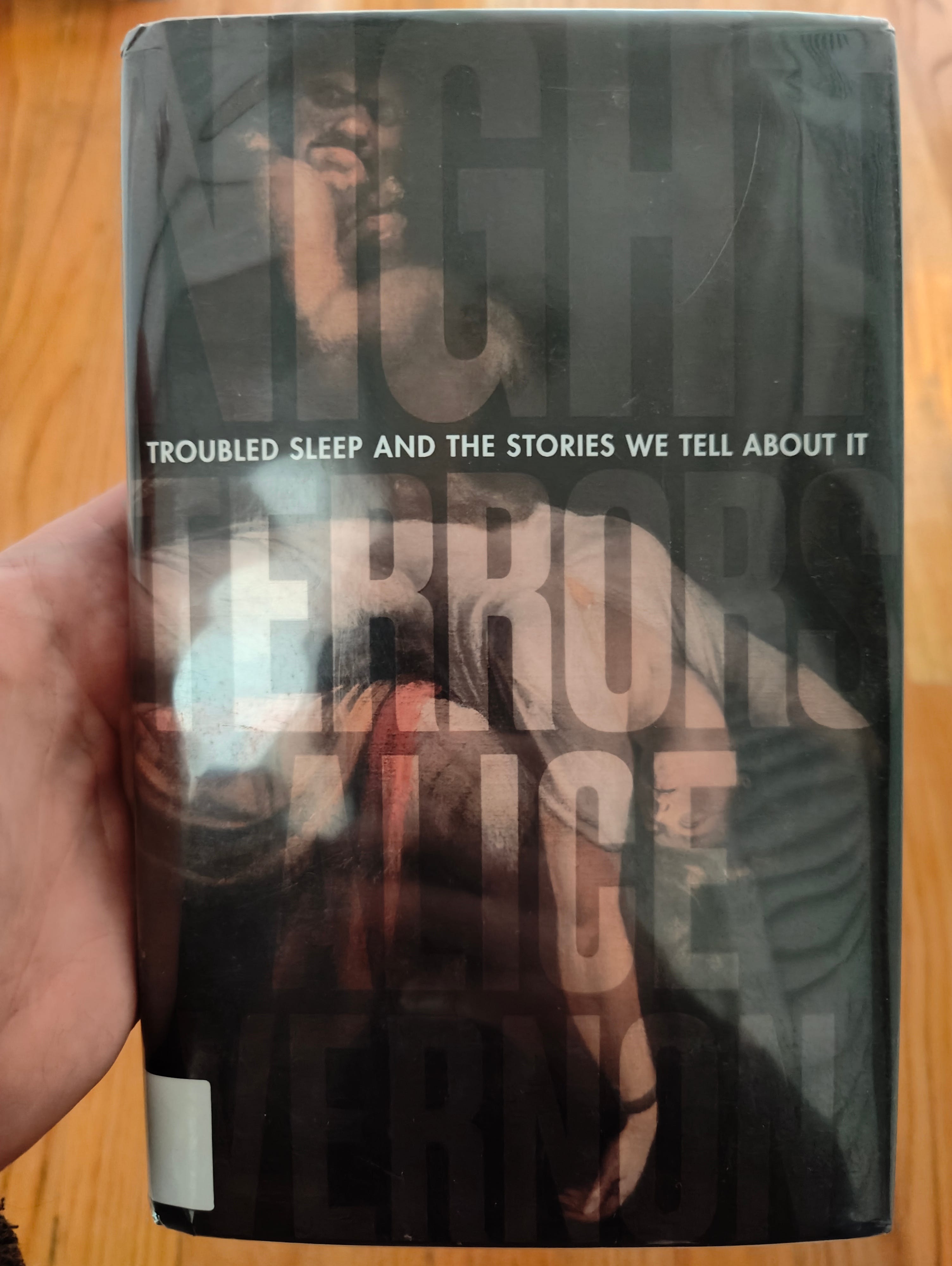
Night Terrors
Troubled Sleep and the Stories We Tell About It by Alice Vernon

Melancholy Matters consists of musings on the meaning(s) of sadness. It’s my attempt to uncouple feelings of sadness from feelings of wrongness.
I was worried for a second that I might have gone blind. It was pitch black, but I could have sworn that my eyes were wide open. As they started to adjust, I found myself on the floor by the front door of our one-bedroom apartment. I must have run into something and fallen over. I remember being worried I might have shattered our glass coffee table, but I had just knocked it down. Someone was banging on the door. I had woken up one of our neighbors, and they came over to see if everything was okay. I was still half asleep, but I tried to reassure them that I was fine. I couldn’t feel one of my arms because it was pinned under my body. It would take several minutes for the feeling to come back into my hand.
Coming down from such an adrenaline high is not fun. It’s the middle of the night, so I’m already exhausted, but my heart is beating so fast, the most acute fear I’ve ever felt still lingering at the edge of my consciousness. Desperately trying to remember the last few minutes, it seems to fade at the same rate that I grasp for it. My knees are bloody, and I’ve stubbed a few of my toes. As the adrenaline subsides, the dull pain in my side becomes sharper. I must have run into the corner of the island in the kitchen, because a bruise is already starting to form on the back side of my ribs.
I start to calm down, hoping the pain will subside and that I’ll be able to feel my fingers again. I must have been clenching so hard. The muscles in my forearm are still so stiff that I worry they are locked in place. I lay propped up in bed for a while, hoping I’ll fall asleep again soon. I’m not terrified anymore. But I’m still afraid, afraid that this will keep happening. It wasn’t the first time.
Night terrors, along with lucid dreams, sleep paralysis, somnambulism, and hypnopompic hallucinations are some of the phenomena known as parasomnias. Recent surveys show that about 70% of the population experience a parasomnia at least once in their life, but, as common as they are, they are rarely talked about publicly.[1] I had my first night terror in 2022. I don’t remember much of what happened before I woke up near the door to my apartment, but I know I was running from something, so terrified and desperate to get away that it didn’t matter that I had fallen several times and run into a few walls. I had apparently been screaming loudly enough that our neighbors had called the police.
In Night Terrors: Troubled Sleep and the Stories We Tell About It, Alice Vernon discusses the literary and cultural significance of several parasomnias along with her personal experiences of hypnopompic hallucinations, dream-like images that are mistaken as real, and sleepwalking, or somnambulism, “the phenomenon of moving and undertaking complex physical actions despite being asleep.”[2] Throughout the book, she shows how dreams and other nighttime experiences are repackaged to tell a story, stories that have gripped imaginations for hundreds of years. But these are stories that we also tell ourselves to give our sleeping selves a particular meaning. When we think and write about our sleeping selves, we establish a relationship with a part of ourselves that we can’t ever really know.[3] When I first started having night terrors, that was the scariest part. Every time I go to bed, I have to trust this other part of me to not go on a rampage in the middle of the night.
When I was a senior in high school, my physics teacher told me, unprompted, that I would explode one day. It was quite an ominous thing to say to a 17-year-old, and I’ve wondered recently what he meant by it. He must have noticed that I was keeping things in, that there was something I was refusing to let out. And now, I go to bed every night worried that this other guy is going to come out, someone that I’ve been forcing for thirty years to experience all the emotions I haven’t wanted to. But who is he running from? Or is it me who is running from him? Is he trying to get me to see him or something else, something that I’m too scared to see?
Sometimes, after I wake up from a night terror somewhere in my apartment, I wonder if what’s just occurred has actually happened to me. It feels as if someone else experienced fear and then gave it to me as soon as it reached its peak. I wake up and feel someone else’s fear, but it’s as if the object of fear isn’t mine. I’ve just borrowed it for a second so that I can catch a glimpse of what they are feeling. What are they feeling whenever I’m feeling fine, whenever I’m awake? Are they constantly in a state of fear, and sleep is the only opportunity for them to get some reprieve by giving it to me?
We still aren’t sure what causes night terrors. There could be no specific underlying condition, or it could be the result of a traumatic experience, or the precursor of a serious disease like dementia.[4] But these health-related explanations don’t frighten me. What frightens me is the reality that I don’t know what I’m capable of. I can’t trust myself to have a safe night of sleep. And those who sleep near me can’t trust me either. Maybe my night terrors are an expression of a fear that I have yet to confront. Or they express a repressed desire that I don’t want to know that I have. The thing I’m running from in my sleep, in this case, is not an imagined version of someone or something that I was traumatized by in the past, but rather, myself. I’m running from the version of myself that is catching up to me, one that I’m, for some reason, afraid of becoming or contending with.
I’m not sure what kind of relationship I’d like to have with this ‘other’ me who gets up to things at night. He seems to be a lot more paranoid and anxious than me, or maybe I’m feeding him those emotions because I don’t want to deal with them myself, and sometimes he lashes out because of it. So far, I’ve had to reduce this phenomenon to a physical health problem. After having a night terror once every six months or so for a few years, the event I described above resulted in a broken rib. But it didn’t break because I ran into a blunt object. I’m convinced it broke because I was sleeping on my arm, and the pressure not only broke my rib but also caused me to have a panic attack in my sleep due to a lack of oxygen. After consulting a sleep doctor and doing a sleep test, I was diagnosed with moderate sleep apnea. I’ve been using a CPAP machine for over a year, which has greatly reduced the occurrence of my sleep-related disturbances. But I can’t help but think that I’m only addressing it on the physical side. There’s also a psychological side, a story to be told about my specific traumas (probably related to doing a PhD), as well as a psycho-social side.
It would be too simple to reduce this to an individual health, or even mental health, problem. Vernon notes that hallucinations and other parasomnias are on the rise, which might be an indicator that a social pathology is at play rather than just individual ones. What is it about our contemporary society that makes our brains hallucinate more than in the past? I would think that it has something to do with contemporary social and economic conditions along with recent and rapid changes in technology and the use of social media. Our brains may always be “present,” but our minds are constantly projected all over the world much more than they are concerned with our immediate environments. How much are the conclusions drawn from information gathered from screens “hallucinations” constructed in the background by social media platforms trying to hijack and manipulate our attention?
The world today might be making us more psychotic, something that is also going to affect our sleeping selves. More people are experiencing parasomnias, but rather than just talking about them to normalize them, I want to talk about them so that my madness can be situated with respect to a collective one. I want to feel less alone in these experiences, but I don’t want to feel less mad or somehow “cure” myself so that I am rendered “sane”. I’d rather embrace my own, and our collective, madness. Because if we don’t, I think we’ll explode.
[1] Alice Vernon, Night Terrors: Troubled Sleep and the Stories we Tell About It (Icon Books, 2022), 3.
[2] Vernon, Night Terrors, 30.
[3] Vernon, Night Terrors, 33.
[4] Vernon, Night Terrors, 153.